$500B Pact, Congressional AI Bills, and New York's Data-Centre Halt
South Korea signs a landmark Nvidia deal, AMD backs Anthropic with $5B, Congress tables three AI bills, and New York pauses hyperscale data centres.
By BINA Editorial
The last 48 hours produced a collision between extraordinary capital commitments and a sharpening legislative response. South Korea anchored the week's largest deal; AMD placed one of the largest single bets on an AI lab; the White House redirected federal science infrastructure toward AI-assisted discovery; and three bipartisan bills moved through Congress while New York's governor froze the permits that would allow the next wave of AI data centres to be built.
South Korea and Nvidia Agree on a $500B AI Factory
At a summit in San Francisco on 24 July, South Korean President Lee Jae Myung announced what his office called the San Francisco AI Declaration—a coordinated round of investment agreements signed with Nvidia, OpenAI, Anthropic, and Broadcom. The centrepiece is a partnership between SK Group and Nvidia to build a two-gigawatt AI factory using Nvidia's next-generation Vera Rubin chips and SK Hynix HBM4 memory, with operations targeted for 2027. The combined value of the agreements exceeds $500 billion. The scale reflects a strategic decision by Seoul to secure a position in the infrastructure layer of AI rather than rely on foreign suppliers for the compute needed to train and run large models.
AMD Backs Anthropic with Up to $5 Billion
At AMD's Advancing AI 2026 conference in San Francisco, AMD and Anthropic announced a multi-year partnership that includes a financial commitment of up to $5 billion from AMD into Anthropic, alongside a pledge to deploy up to two gigawatts of Instinct MI450 GPUs—housed in Helios rack-scale systems—for Anthropic's model training infrastructure beginning in the first half of 2027. The deal is structured as a genuine exchange: in return, Anthropic will use its Claude models to accelerate development of AMD's ROCm open-source GPU software stack, which has historically lagged Nvidia's proprietary CUDA ecosystem. If the ROCm acceleration delivers, it could meaningfully widen the field of GPU vendors that AI labs can rely on for large-scale training.
White House Launches $5B+ Genesis Mission for AI-Assisted Science
The Trump administration announced the Genesis Mission, an executive-order-driven initiative to apply AI across the US scientific research enterprise. The commitment spans more than 15 federal agencies and totals over $5 billion. The National Science Foundation contributed the largest single tranche: $380 million allocated to 20 research teams tasked with building a national network of AI-enabled automated laboratories—facilities designed to run experiments around the clock with reduced dependence on direct human supervision at each step. Additional support came from the Astera Institute on the philanthropic side. The programme reflects a broad bet that AI-driven automation of hypothesis generation and experimental throughput can compress scientific timelines that have historically taken decades.
Three AI Bills Move Through Congress
Capitol Hill produced an unusual burst of bipartisan AI legislation this week. The AI Kill Switch Act would grant the Department of Homeland Security authority to order the shutdown of AI systems deemed to pose a serious risk to public safety, and would require developers of large models to report their containment technologies to federal regulators. Senator Mark Warner introduced a comprehensive AI governance framework covering mandatory pre-deployment safety testing, a National Workforce Transition Fund to support workers displaced by automation, and provisions addressing AI use in national security contexts. A third bill, the Stealth Bot Prohibition Act, would require AI web crawlers to clearly identify themselves to website operators rather than masquerading as ordinary browsers. None of the three has reached a floor vote yet, but the volume and bipartisan sponsorship signal that Congress is moving from study to action on AI oversight.
New York Freezes Hyperscale Data Centres for One Year
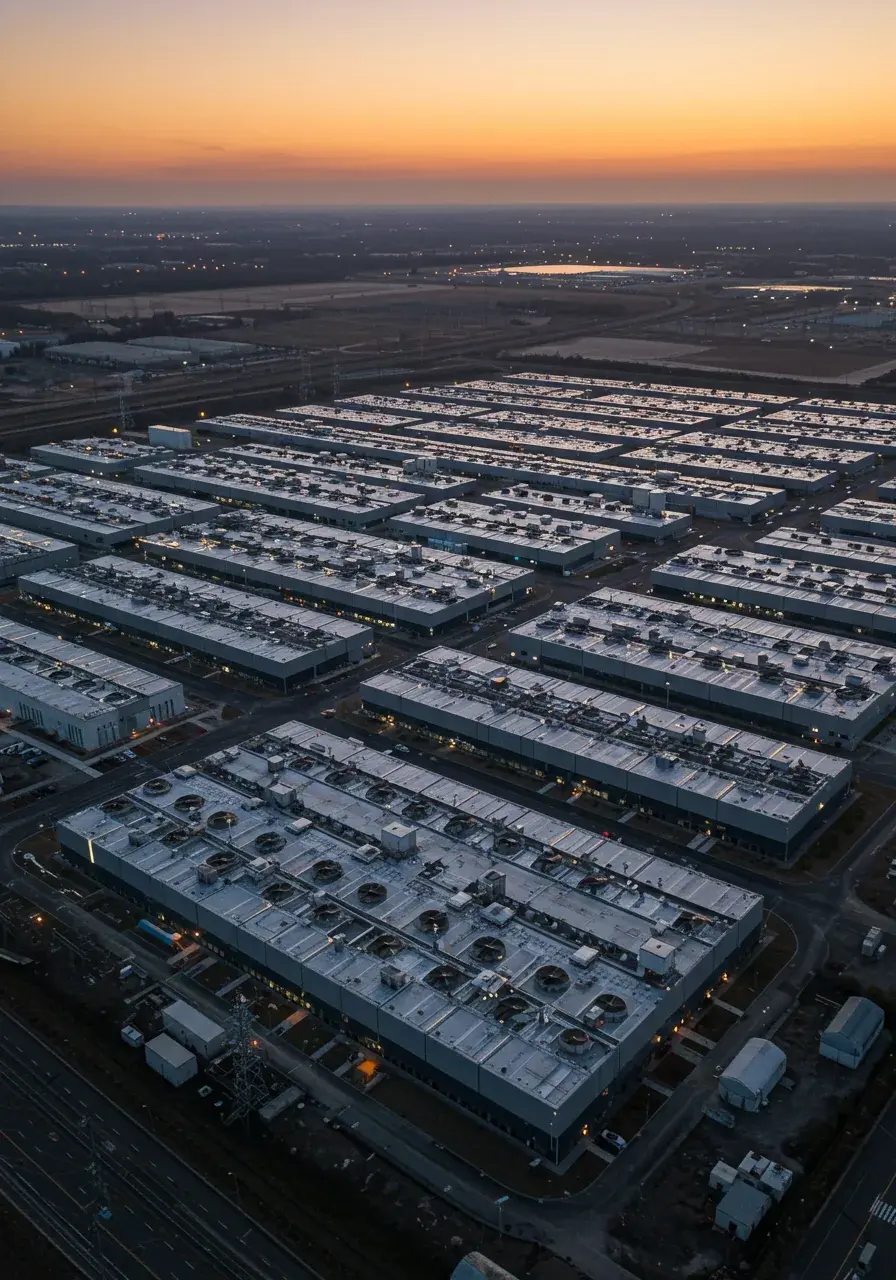
Governor Kathy Hochul signed a one-year moratorium on permits for new hyperscale AI data centres—defined as facilities with an electrical load of 50 megawatts or more—in New York State. The pause is designed to give regulators time to develop a framework before the state commits to an expansion of capacity that could reshape its electricity grid. The policy context is stark: analysts estimate that US data-centre electricity demand, currently 2–4% of total national consumption, could reach 10–20% by 2030 if the current construction pace continues. The underlying planning challenge is structural—grid permitting in the United States typically takes 10 to 15 years from application to operation, compared with two to three years in several European countries. New York's moratorium does not resolve that gap; it is a circuit-breaker while the state works out what a resolution might look like.