AI in Medicine: Robot Surgery, Hidden Lesions, and Prescription Risks
Five stories on how AI is reshaping surgery, diagnosis, mental health, and prescription safety in mid-2026.
By Dr. Asher Knippel
The day's five stories share a single thread: artificial intelligence has moved from research lab to clinic, with results that are sometimes astonishing and sometimes alarming. A humanoid robot has steadied a surgeon's hands inside a real patient. A new algorithm has found thousands of MS lesions that experienced radiologists missed. And yet two separate investigations this week warn that AI applied to prescriptions and mental-health support is running ahead of the oversight that patients deserve.
Friday, 10 July: Robot Hands in the Operating Theatre — A World First in San Diego
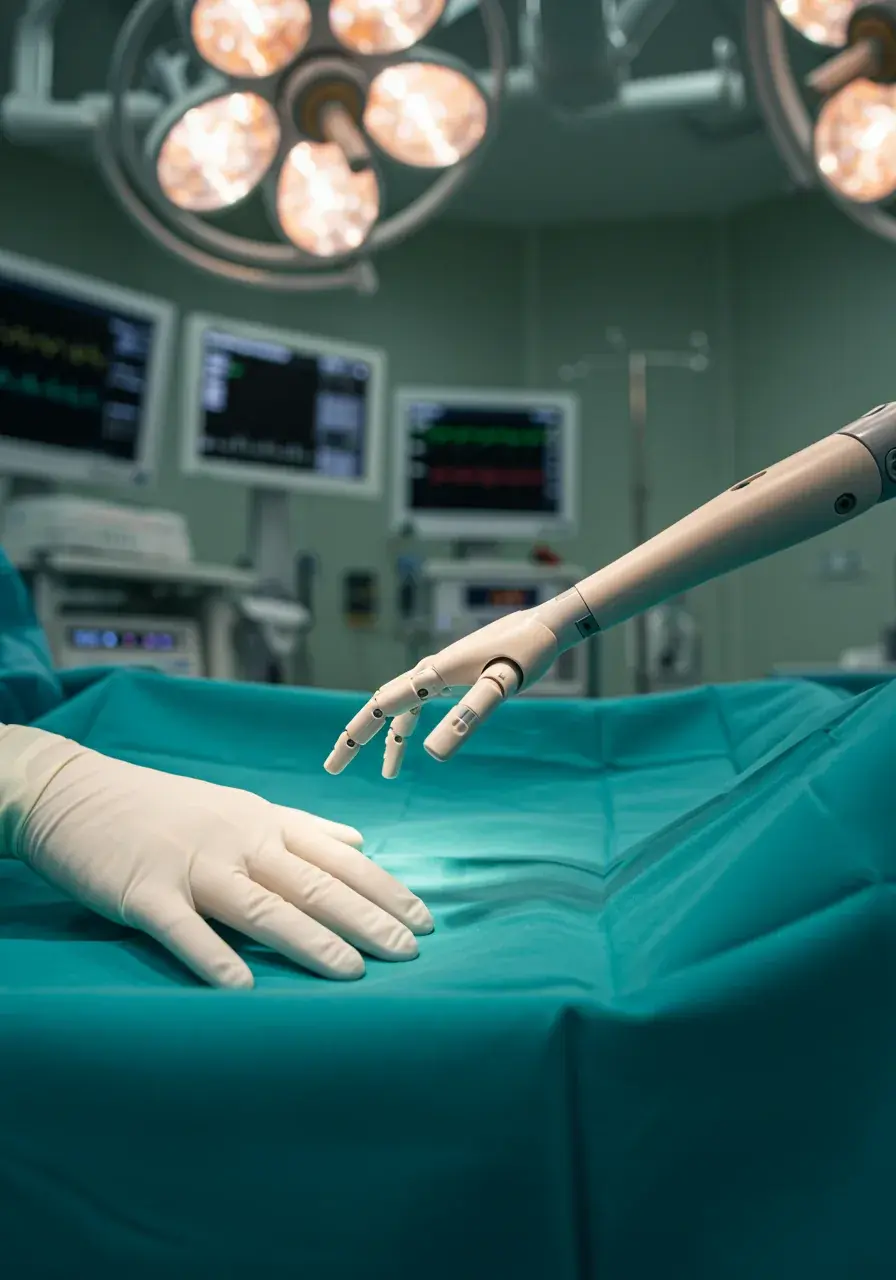
Surgeons at the University of California San Diego's ARCLab have reported the first use of humanoid robots to assist in live human surgery. In early July 2026, Unitree G1 robots — general-purpose machines not designed specifically for medicine — were used in seven cholecystectomy procedures (gallbladder removals), guided by motion-capture technology that translated a surgeon's hand movements into robot actions in real time.
The robots did not act autonomously. At every step, a human surgeon controlled the movement; the robot served as a mechanical extension of the operating hand. The ARCLab team is clear on what this was: a proof of concept, not a clinical tool ready for widespread deployment. No adverse events were reported, and the research team plans to publish peer-reviewed findings once the data are fully analysed.
Why does this matter? General-purpose humanoid robots are manufactured at scale and cost a fraction of dedicated surgical systems like the da Vinci platform. If the approach can be validated in controlled trials, it could eventually widen access to precision surgical assistance in lower-resource hospitals — including those in the eastern Mediterranean region. That is a distant prospect, but the proof-of-concept is now on record.
Friday, 10 July: Hidden MS Lesions Found by Algorithm in Thousands of Existing Scans
An international team led by the University at Buffalo published findings in Communications Medicine on 7 July 2026 that challenge how multiple sclerosis has been tracked for decades. Using a new image-processing method called MMCLE (Multi-contrast MRI Cortical Lesion Enhancement), researchers re-analysed MRI scans from the large ORATORIO clinical trial and identified more than 11,000 cortical lesions that conventional MRI had missed — an average of 15 to 20 additional lesions per patient.
Cortical lesions, located in the brain's outer grey matter, are strongly associated with cognitive decline and physical disability progression in MS. Standard clinical MRI protocols struggle to resolve them because the grey matter is thin and the lesions small. The MMCLE technique works on scans that were already taken — no new MRI hardware is required — by combining existing contrast sequences in a way the algorithm has learned to exploit.
This is a meaningful finding for the roughly 2.9 million people living with MS worldwide. Better lesion detection means better disease staging, better clinical trial design, and potentially earlier intervention. The technique is not yet in routine clinical use, and validation across diverse MS populations and scanner types will be needed before any guideline changes.
Friday, 10 July: AI Maps the Immune Signals That Separate Ebola Survivors from Non-Survivors
Researchers from the University of Liverpool, Spain's Instituto de Salud Carlos III, and the European Mobile Laboratory have published a study in the Journal of Infectious Diseases using AI-driven transcriptomic analysis of blood samples collected during the 2013–2016 West Africa Ebola outbreak. The analysis identified immune-response biomarkers that predict survival more accurately than viral load measurements alone.
The findings show that age and biological sex affect the immune trajectory during Ebola infection in ways not fully captured by current risk-stratification tools. Younger patients and female patients showed distinct cytokine patterns associated with better outcomes. The FDA has indicated endorsement of the research direction as a framework for future diagnostics in filovirus outbreaks.
For clinicians working in outbreak response — including European Mobile Laboratory teams that have deployed across central and west Africa — better early prediction of which patients will deteriorate rapidly could guide allocation of intensive-care resources and experimental therapeutics. The study uses archived samples; prospective validation in a future outbreak will be required before clinical adoption.
Friday, 10 July: AI Chatbots Are Renewing Prescriptions Without Physician Oversight
A patient-safety concern emerged this week: AI-powered tools, including the service Doctronic, are renewing prescriptions in Utah, Texas, and Wyoming through regulatory workarounds that allow telemedicine prescribing without a prior physician–patient examination. Physicians' organisations have raised concerns that patients on complex or high-risk medications — including antidepressants, anticoagulants, and thyroid drugs — may have doses renewed without anyone reviewing recent laboratory values, contraindications, or drug interactions.
The FDA has not authorised any AI system to prescribe medication and has stated it is monitoring the space but has not yet taken enforcement action. State regulators in the three states involved have not moved to restrict the practice. The companies argue their tools fall under existing telemedicine exemptions.
This is an open regulatory gap, not a resolved question. Safe prescribing for chronic medications requires knowing the patient's current condition, not merely their past prescription history. Patients who are offered AI-only renewal should ask whether a licensed physician has reviewed their current health status before accepting it.
Friday, 10 July: Mental Health Chatbots Face First Legal Bans and a Safety Commission
In a parallel development in AI-assisted care, the UK mental health charity Mind published findings showing that 60% of people with mental health needs who sought digital support in 2026 chose an AI chatbot over NHS talking therapies. Nearly 10% of safeguarding concerns logged by Mind in the same period were linked to AI-related harm.
Rhode Island has become the first US state to ban AI therapy chatbots in clinical settings and to require clear disclosure of AI involvement in any clinical mental health session. Mind is launching a 12-month independent commission to investigate the harms and benefits of AI in mental health support.
The underlying tension is real. Waiting lists for NHS psychological therapies run to months; AI chatbots are immediately available, free of charge, and carry none of the stigma sometimes attached to seeking help. But a chatbot is not a clinician. It cannot assess suicidality with the rigour of a trained therapist, cannot prescribe or adjust medication, and cannot make a formal safeguarding referral. The Mind data suggest that for a significant minority of users, something is going wrong. The Rhode Island ban and the Mind commission are early responses to a gap that will require considered national-level policy in most countries.
This article is for journalistic purposes only and does not constitute medical advice. Readers should consult a qualified healthcare professional before making any changes to their treatment, medication, or health management.